Our Mission:
Greening Urban Spaces
Ninebark is a Calgary, Canada based non-profit organization dedicated to improving city green space for all through strategically planting resilient trees and shrubs in our urban areas.
Join us in our endeavor to create a greener and more sustainable urban environment. Together, we can make a difference in our communities and pave the way for a healthier future.
Meet Our Team

Noah Edwards
Noah Edwards is a recent Queen’s University structural engineering graduate. He has worked for several years in the field and has developed a keen interest in urban planning, architecture, green innovation, gardening, and the philosophy of the city.

Peter Edwards
Peter Edwards is a Queen’s University MIR grad and human resources / industrial relations specialist with decades of experience in the railway industry. He spends his free time studying new and climate oriented technology, consulting and leading groups such as Queen’s Open Plastics, and staying curious.

Mo Oishi
Mo Oishi holds a PhD in plant biology (Guelph) and a MJ (UC Berkeley). He is a communications strategist and copywriter who has worked in the agricultural, clean and digital tech, and financial sectors. A dedicated volunteer, he loves and promotes ideas that facilitate a more collaborative, sustainable future.

Our Amazing Volunteers
We have a passionate group from all across Canada working to make a real difference in our communities. We have dedicated groups of volunteer planters, botanists, graphic designers, legal experts, communications experts, and more.
Concept Document
Below is an abridged version of the detailed concept document outlining the purposes and methods of Ninebark. Download the full PDF using the button below.
Ninebark Concept Document
Executive Summary
Ninebark is a non-profit organization dedicated to improving city green space for all through strategically planting resilient trees and shrubs in our urban areas. Underutilized and underfunded locations identified as having potential, and which otherwise would be unlikely to receive similar investment, are selected in order to achieve maximum positive impact. This includes projects such as but not limited to plantings at schools, on streetsides, in parks, and on the properties of people who otherwise would not be able to afford it. While the City of Calgary and other municipalities do have initiatives to increase urban canopy, they are mostly centered around boulevards and major urban avenues. It is our aim to fill in the gaps in other areas that desperately need it with a wider variety of trees and shrubs. As an initial objective, we are aiming to collect donations of around a few thousand dollars a year and use it to complete one or two select projects. We believe that access to nature in cities is a fundamental human right, good for people, the local environment, and the climate, and greatly enhances the character and livability of our urban spaces. Everybody deserves a part of these benefits, and it’s our mission to ensure they get it. This document explores the purpose, goals, and scope of Ninebark in detail.
Problem Statement
With more than 68% of the global population predicted to reside in cities by 2050 (United Nations, 2018), it has become essential now more than ever to ensure that the urban environment is designed thoughtfully and effectively to promote well-being in the human psyche. A lack of third spaces, loneliness, heat islands, increased air pollution, and a lack of neighbourhood character are all issues that have arisen in the modern city, particularly in suburbia, due to a complex mix of variables including developer constraints, scarce funding for government programs, and feelings of disownership of community members over their public spaces (Montgomery, 2013). It is essential that these problems which plague many cities, Calgary included, be addressed during this time of renewed urban growth.
Green spaces and diverse, varied pockets of nature have been proven to be essential to the fabric of a healthy urban landscape through the effect they have on its inhabitants. In fact, trees, shrubs, flowers, and other greenery have been shown through widespread scientific study to address many of the common and increasing urban issues described in this section. Great green spaces act as third places and facilitate everything from serendipitous social interactions to friendly group gatherings to community events (Kingsley, 2021). Large canopy trees have been shown to decrease street temperatures by several degrees (Ettinger et al., 2024), which has been shown to drastically reduce electricity bills, decrease levels of anger and stress, and potentially even make society less violent (Berman et al., 2020). Plants scrub our air and make it less polluted, less dusty, and reduce noise levels, which is especially important near car traffic or construction. Replacing standard grass lawns with native and water-wise plants drastically reduces watering and lawn maintenance costs for governments and private individuals alike. Having planted areas with permeable soil instead of concrete islands brings down stormwater infrastructure costs which have ballooned recently due to rainfall events of increasing intensity (Denchak, 2019). Mature trees and access to green space are highly correlated with increased property value (Ewane, 2023). Hospital patients with views of nature out their windows have even been shown to recover more quickly than those with a view of a brick wall, even if they receive the same level of care in the same facility (Ulrich, 1984). The list of benefits of integrating nature into urban areas continues on and on, growing larger and more robust every year with an ever increasing body of scientific research. Even without all of the peer reviewed studies, indeed it is obvious to see that plants are also just a beautiful part of nature which supports local wildlife, lends immense character to a neighbourhood, and which everyone can appreciate.
Figure 1: Medellin, Colombia, where their Green Corridors initiative has succeeded in reducing temperatures by 3℃ on average by casting shade onto areas that would otherwise be hot tarmac (Gouvea de Andrade, 2023). Through personal experience, this makes a world of difference.
Calgary is behind on modern initiatives to regreen public spaces, and while the city has pledged to increase urban greenery and recognized the problem, little official measures have been taken. The city remains woefully behind global and national averages on important metrics like canopy cover, where it measures in at 8.25% while cities like Edmonton weigh in around 13% and Toronto and Vancouver around 30% (Lett, 2025). Even areas of Calgary situated in the high prairie environment can support a sizeable variety of trees in more sheltered areas and a huge diversity of incredible native shrubs, flowers, succulents, and grasses in more exposed ones. We can embrace our local ecology and climate instead of trying to fight it or giving up entirely. Greening and beautifying our public spaces brings life and character back to a city that can have so much more to offer than the same bland concrete islands and lawns seen everywhere across North America. Calgary is beautiful and unique in many ways, not the least ecologically, and its inhabitants deserve greener, more functional public spaces that highlight the uniqueness of the local ecology and provide more urban access to nature in general.
Nature has a profound and intrinsic effect on the human mind and our wellbeing, and its presence, variety, and accessibility in cities is one of the most important aspects of urban life that we must safeguard for ourselves and future generations.
Mission Statement
The stated mission of the Ninebark Non-Profit Organization is to address the discussed issues in the problem statement as best we can by increasing or ameliorating green space. Simply put, we will raise funds, assess areas of weak urban greenery within the City of Calgary that would benefit from more plant life, and then deploy the funds with teams of volunteers to purchase, plant, and maintain new greenery in Calgary. We will weigh potential candidate sites with a set of criteria to determine where we will be most successful and have the greatest possible impact, and then we will go out and slowly make Calgary a better, healthier, and more sustainable place to be.
Ninebark is a Canadian native plant that is tough as nails, ecologically essential, a keystone to members in its natural community, and downright charming. In naming our organization after it, we hope to embody these admirable traits in our work as best we can in our mission to green our city.
Figure 2: A historic boulevard in Calgary, Alberta, where mature trees planted decades ago enrich our lives today.
Goals and Target Projects
City
-
Schools and Community Centres
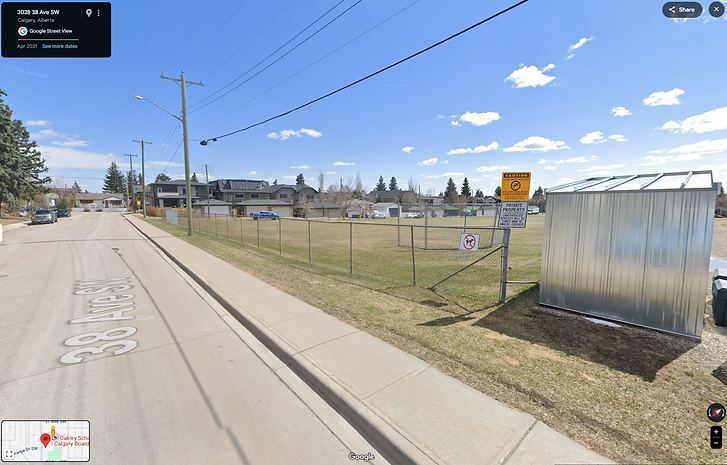
Schools and community centres are obvious candidates for improved greenery as they directly impact a large number of people and are often on huge lots. A prime example of this is Dr. Oakley School in SW Calgary, which is on a huge lot that is mostly just a scorched, abandoned field in the summer. The addition of shade trees and other vegetation here could greatly improve the functionality of the space and make it more attractive as a third place for members of the community after the school session is done. A memorial program could also be adopted and implemented here, where clients could donate and have a memorial stone or plaque placed under a tree.
Figure 3: Dr. Oakley School’s lawn in Calgary features very little planting and is hardly used for a green space of its size and location in the middle of a residential neighbourhood.
Dr. Oakley School is being studied as a potential first candidate site. Please refer to or contact us for the official project document that discusses site selection reasoning and justification, feasibility and logistics, costs and fundraising, plant species specifics and planting arrangement, legal, and more.
-
Boulevards
There are many grass medians that appear to be intended as boulevards in Calgary, however just consist of dead grass and weeds. Planting here would improve roadway aesthetics and help cool down the street by casting shade over hardscape surfaces. The use of trees and native, or otherwise water-wise, plants would also greatly reduce the maintenance cost of maintaining the space as it would not need to be mowed, weeded, or watered.
Figure 4: Memorial Drive in Calgary is an excellent example of treed boulevards being implemented effectively.
-
Unused Intersection Space
This is a similar issue to that of the boulevards, however sightlines would have to be considered for pedestrian and vehicle safety. Smaller, ground hugging plants and trees with canopies well above the ground would be functional remediations for these sites.
-
Utility Grass Strip
The same principle applies as the boulevards; planting hardy trees and shrubs would improve neighbourhood aesthetic, cool down the street by casting shade onto it, and reduce maintenance costs related to mowing, weeds and drought.
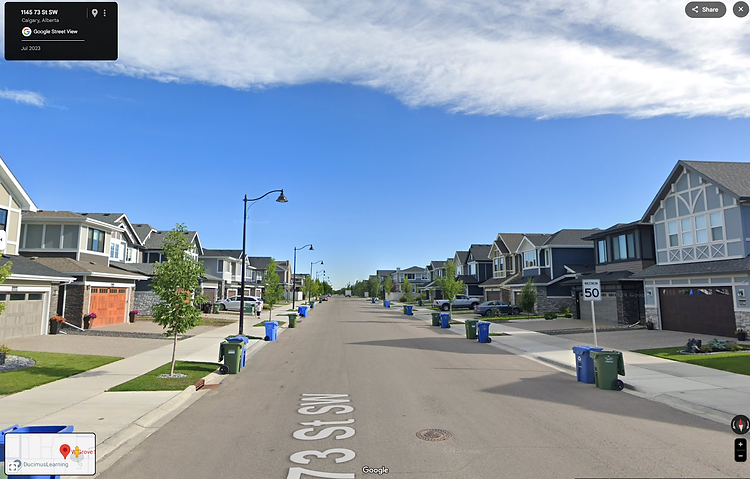
Figure 5: A new development in Calgary that incorporates tree plantings on the utility grass strip. Once these trees mature, this street will resemble the one shown in Figure 2 and gain the numerous benefits of a green canopy.
-
Parks
In areas where parks are under-planted or neglected, new greenery could be strategically placed to maximize the beauty and utility of the space. The memorial program could also be implemented here.
Private Business
-
Private Business / Property Owners
Green areas on the properties of private businesses could be amended to improve neighbourhood quality. This would also likely be a boon for local business as studies have shown that green, welcoming spaces better attract potential customers and lead them to stay longer (Joye, 2010).
Figure 6: A street in Northeast Calgary that is very typical of the city. These areas could benefit greatly from shade trees, native shrubs, or other natural additions to increase the aesthetic appeal and functionality of the space.
-
Churches and Other Religious Buildings
Churches and other religious buildings are similar to schools and community centres in that they are often on larger lots and can function as multi purpose areas for communities. Green space at these locations can be improved to make the street a more pleasant place to be or convert them into more complete third places for the neighbourhood. Memorials could also work well here.
Figure 7: St. Aidan’s in The Beaches, Toronto, and the adjacent apartment block have planted canopy trees on their property lines which lend character and shade to the street in a cohesive and cost-effective way.
Residential
-
Residential Owners
Residential property owners could also be contacted to see if they would like trees or other greenery planted on street-facing parts of their properties to maximize community benefit. This would be specifically offered in areas deemed having the highest ratio of possible success rate to biggest impacts, and would primarily be directed at low-income residents.
Figure 8: Grove Street, Calgary Alberta, where the only “greenery” that exists are patches of dead grass, and the adjacent city-owned trail that proves that plant life can exist in abundance in the area.
-
Residential Renters
The same ideas described above apply to renters, although the added step of contacting the property owner for permission would need to be considered.
Figure 9: 13th Street in Vancouver features beautiful rows of mature chestnut trees that provide character, greenery, and shade to the area. Notice the difference between here and Figure 6.
Methods
Marketing
Marketing for the organization is essential for raising the funds to complete projects. Spreading the word will be completed in a number of ways, including:
-
Knocking door to door to see if anyone is receptive
-
Market by Instagram and other online platforms
-
Website and email
-
Business cards with QR code to website/social media account/email
-
Have a presence at local markets in the form of an information booth
-
Reach out to companies who might want to sponsor, including companies that volunteers are employed at, and also to green/climate groups in Calgary doing similar work
-
Petition the city/community associations/developers for funding/volunteers/campaign exposure
-
Host events/parties for volunteers and donors
Recruitment
-
Volunteers will most likely primarily be discerned and retained by word of mouth
-
If the need is required, volunteers could be sourced through the same methods as mentioned in the marketing section
Operations
-
Contact potential project candidates as described in the Goals and Target Projects section and provide preliminary models or examples of similar work that has already been completed
-
Get groups of volunteers to commit to a few dates a year of planting in the spring and fall
-
Contact plant nurseries for potential discounts
-
Either rent trucks to carry the supplies on the days where work is being done or borrow them from volunteers
-
All admin tasks will be performed by volunteers using free software to spend as little as possible
Donations and Finances
-
Collect donations throughout the year
-
Initially go through etransfer and cash, later set up a credit/debit system to accept donations that way
-
A Gofundme could be set up to gain donations and exposure
-
Donation options could be included such as memorial/commemoration with a plaque, sponsorship plaques from companies, a tier list for donation amounts, “donate enough for one tree and leave a legacy”, recurring or gift donations, etc.
-
Partnerships could be made with greenhouse for discounts through advertising/bulk orders
Model Project Timeline
I Candidate Solicitation
The team will scout around the city for potential candidate sites, contact potential candidates, weigh projects using the matrix, and then select a project.
II Project Scope Identification
The breadth of the project will be identified and a formal proposal will be made. This will include timelines, lists of volunteers, materials, and financial details. If an expert opinion is deemed necessary for the project, one will be sought and retained.
III Candidate-Side Project Confirmation
The proposal will be sent to the candidate to sign-off on. This will include all relevant legal paperwork to be signed and returned to Ninebark.
IV Ninebark-Side Project Confirmation
If the candidate accepts, the proposal will be sent back to Ninebark and signed-off on by our team. We will confirm it here and formalize project preparations.
V Logistics and Team Preparation
The project outline will be drafted and introduced to the entire Ninebark team. A formal schedule and materials list will be developed, along with written confirmation from all volunteers that they will be available on the chosen date.
VI Planting Day
All personnel selected to aid in the materials pickup will meet earlier and make their way to the garden centre of storage location if materials have been previously procured. They will then make their way to the project location to meet up with the other volunteers at the predetermined time. A brief stretching circle, safety equipment check, water and snacks check, and work briefing will be provided before the volunteers will break off and set to their specific tasks. Once the day is done, cleanup will be completed and the project recipient will be notified of completion. This will include a legal sign-off stating that project work has been completed which will be signed by both parties. If it is a multi-day project, efforts will be made to reach agreements with the candidate ahead of time to allocate areas for equipment and material storage while the project is ongoing. A more thorough logistical plan will be completed for each individual project before work on site begins.
VII Follow-Up
The project site will be visited at various predetermined times during the year to ensure proper maintenance and health of the plants. These maintenance and health checks will endure for, at maximum, the legal duration of maintenance that Ninebark is required to provide for the installed assets. This is described further in the Legal and Incorporation section of this document. Ninebark may also visit the site due to requests by the client during this period. Regular watering appointments may also be made during this period if it is agreed upon by Ninebark and the client. A project review will be conducted by Ninebark following completion to improve efficiency and competency for the next one. Social media streams will also be updated with images of completed projects and the volunteers who made it possible, and plant care sheets will be sent to the client.
Matrix
This section exists to clarify the decision making process and various factors involved when selecting a potential candidate site. This will likely change and evolve with lessons learned over time.
Impact
Great weight in decision making will be given to the overall impact a given project can have on the city. If a project has the potential to affect a lot of people very positively or is in, for example, an underserved area, it will gain points relative to other potential projects that may not make such a significant change.
Long-Term Success Rate
The long-term success probability of a project is very important. For example, if a potential project is in an area of Calgary that is known to be exposed to harsh prairie winds, has incompatible soil, or has clients that do not seem interested in upkeep and maintenance of assets, then it will be given less weight in the decision matrix than other deemed to be more likely to succeed in the long run. Support can be given here.
Feasibility
The feasibility of a project must also be considered adequately, as some projects may just be too difficult for our team to complete. This could be due to scale, site conditions, timeline, seasons or inclement weather, and so forth. This may change over time with the size of the team and our capabilities.
Finance
Access to capital is an obvious and considerable factor in project selection. If we do not have enough money for a given project or to see it fully through to the quality desired by our organization and the candidate, then the project may have to be scrapped in favour of another less complicated one. Expensive projects could be slated for completion at a later date when the organization has grown sufficiently and enough funding has been secured.
References
Berman, J.D., Bayham, J., & Burkhardt, J. (2020). Hot under the collar: A 14-year association between temperature and violent behavior across 436 U.S. counties. Environmental Research, 191. https://www.sciencedirect.com/science/article/abs/pii/S0013935120310781
Denchak, M. (2019, March 4). Green Infrastructure: How to Manage Water in a Sustainable Way. NRDC. Retrieved August 12, 2025, from https://www.nrdc.org/stories/green-infrastructure-how-manage-water-sustainable-way
Ettinger, A.K., Bratman, G.N., & Carey, M. (2024). Street trees provide an opportunity to mitigate urban heat and reduce risk of high heat exposure. Nature, 14(3226). https://doi.org/10.1038/s41598-024-51921-y
Ewane, E. B. (2023). Influence of urban forests on residential property values: A systematic review of remote sensing-based studies. Heliyon, 9(10). https://www.sciencedirect.com/science/article/pii/S2405844023076168
Gouvea de Andrade, M. (2023, September 22). The city that went green to keep cool. BBC. https://www.bbc.com/future/article/20230922-how-medellin-is-beating-the-heat-with-green-corridors
Joye, Y. (2010). The effects of urban retail greenery on consumer experience: Reviewing the evidence from a restorative perspective. Urban Forestry & Urban Greening, 9(1). https://www.sciencedirect.com/science/article/abs/pii/S161886670900065X
Kingsley, M. (2021). Commentary – Climate change, health and green space co-benefits. Government of Canada. https://doi.org/10.24095/hpcdp.39.4.04
Lett, M. (2025). A city of trees: The story and struggle of Calgary’s urban forest. The Sprawl. https://www.sprawlcalgary.com/
Montgomery, C. (2013). Happy City: Transforming Our Lives Through Urban Design. Farrar, Straus and Giroux.
Ulrich, R. (1984). View Through a Window May Influence Recovery from Surgery. Science, 224(420). https://rootinnature.ca/research/view-through-a-window-may-influence-recovery-from-surgery/
United Nations. (2018). 68% of the world population projected to live in urban areas by 2050, says UN | United Nations. Welcome to the United Nations. Retrieved August 12, 2025, from https://www.un.org/uk/desa/68-world-population-projected-live-urban-areas-2050-says-un
.png)